
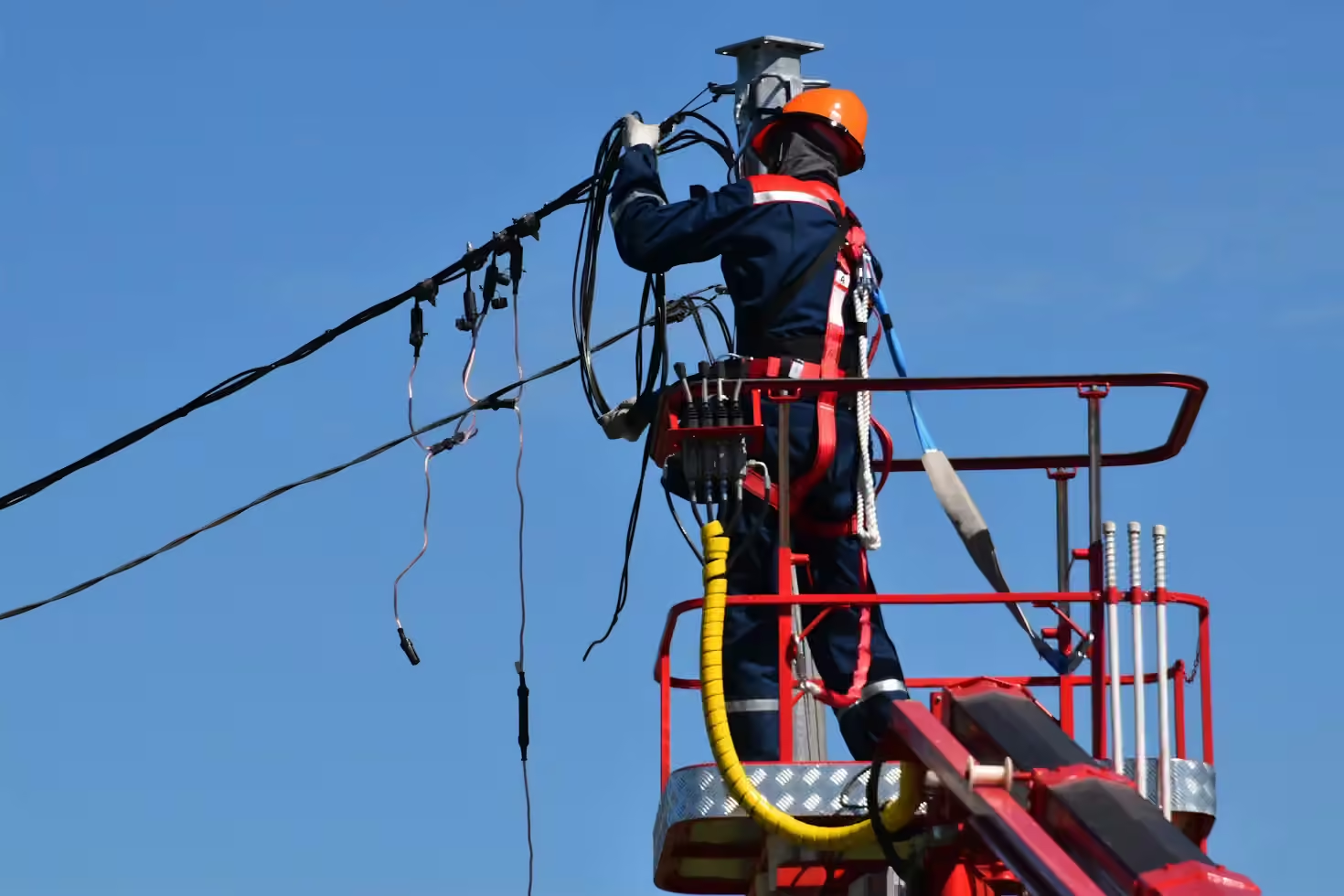
Renewable energy construction is growing fast: rooftop solar, utility-scale arrays, battery storage, and EV charging stations appear on more bid lists every year. But renewable projects mislead contractors who are new to them, because the electrical estimate is not structured like a standard building job. The big line items live in the balance of system, and the total cost includes scope that most electrical estimators never measure.
For contractors who want to capture this growing market, here’s how professional renewable estimates are put together.
The Renewable Energy Market in 2026
The renewable energy market continues to expand as utilities, commercial property owners, and homeowners invest in solar, storage, and EV charging. Federal incentives, state renewable portfolio standards, and falling equipment costs have made renewable projects economically attractive. At the same time, the complexity of these projects has increased as technology evolves and interconnection requirements tighten.
Contractors who can estimate renewable projects accurately have a significant competitive advantage. The contractors who win these bids are not necessarily the lowest bidders — they are the estimators who understand the scope, measure the balance of system correctly, and price the project for the local market.
The Balance of System Is the Core of the Estimate
On a solar project the modules are a commodity. The electrical risk is in the balance of system:
- DC runs between modules, combiners, and junction boxes
- Conductors, conduit, tray, and grounding systems
- AC interconnection, inverters, and the utility connection
- Monitoring, protection, and metering components
A contractor who prices a solar project by counting modules and adding a percentage for “the electrical” is guessing. Every part of the DC and AC path has a unit price, and every gap in that path becomes a change order later.
The balance of system typically represents 40% to 60% of the total project cost. It includes the wiring, grounding, mounting hardware, inverters, combiners, disconnects, overcurrent protection, and monitoring systems that make the array functional. Missing any of these components — or underestimating the labor to install them — turns a profitable project into a claim.
Rooftop and Utility-Scale: Two Different Projects
Rooftop work is a coordination job — racking, roofing, access, and working around existing services — priced in branch-level detail. Utility-scale solar is a civil project: miles of trench, MV collection circuits, pad-mounted gear, substations, and wildlife-protection design.
We take off utility-scale projects by collection block, so every vault, every pull, and every trench segment can be verified and multiplied. The structure of the takeoff has to match the structure of the site; otherwise quantities cannot be checked.
Rooftop solar estimating requires understanding of roof access, load calculations, structural attachments, and coordination with the roofing contractor. The estimator must account for the cost of roof penetrations, flashing, and waterproofing, as well as the electrical scope. Utility-scale solar estimating requires understanding of civil construction, trenching, conduit installation, medium-voltage equipment, and substation design.
Battery Storage: Its Own Engineering
Storage systems bring battery racks, energy management systems, inverters, and HVAC into a single container. The electrical estimate covers the power path around them: racks and BMS, power conversion equipment, transformer and medium-voltage connections, and the interconnection protection chain.
Because battery systems move through codes and insurance requirements quickly, an estimate must be based on the actual equipment submittal — not on a generic assumption about what “storage” often means.
Battery storage estimating also requires understanding of fire codes, ventilation requirements, and seismic anchoring. Battery rooms must meet NFPA 855 and local fire marshal requirements for spacing, ventilation, and suppression. The estimator must include the cost of fire-rated enclosures, ventilation systems, and suppression equipment that are not part of the standard electrical estimate.
EV Charging: Simple Scope, Complex Context
An EV charging station is simple electrically: charger, feeder, panel, metering, and network connection. But the estimate is decided by everything around it: concrete pads, trenching, parking garage restrictions, utility coordination, and the networking and software costs that rarely appear in electrical scope.
EV charging estimating requires understanding of utility interconnection processes, parking layout constraints, and the different charger types and power levels. Level 2 chargers require 40 to 80 amps at 240 volts. DC fast chargers require three-phase power, dedicated transformers, and utility-grade metering. The estimator must price the correct electrical infrastructure for each charger type and include the civil work required to install it.
Interconnection and Utility Requirements
Utility requirements vary by state and by local utility: interconnection studies, permitting, and demand charges differ everywhere, and equipment-only budgets miss the cost of getting an interconnection. Estimates priced at zip-code-region material and labor rates keep the project grounded in the local market.
Interconnection studies can take months and cost thousands of dollars. Utility upgrade costs — transformer replacements, service lateral upgrades, and protective device additions — can exceed the cost of the renewable system itself. Professional estimators include these costs in the estimate and track them through the utility approval process.
Incentives and Tax Credits
Renewable energy projects often qualify for federal tax credits, state rebates, and utility incentives. These incentives affect the project’s economics but do not reduce the electrical scope. The estimator must separate the incentive value from the construction cost so the owner understands the true project budget and the contractor bids the actual work.
Professional estimating services track current incentive programs, calculate eligible tax credits, and document the incentive assumptions in the basis of estimate. This transparency protects both the owner and the contractor when incentive amounts or eligibility change.
How We Estimate Renewable Projects
Apex Electric Estimating Inc prepares electrical estimates and quantity takeoffs for rooftop solar, solar farms, battery storage, and EV charging stations across the USA. We measure the balance-of-system work down to the conductor, combiner, and conduit, price with current distributor data and zip-based labor rates, and structure the report so owners, lenders, and utility reviewers can read it.
The price of a solar project is decided in the estimate: it is the part that has to be measured, not guessed. Get a free quote for your renewable energy takeoff within 15-30 minutes.